Description
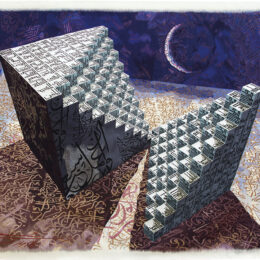
Three Jesting Horses | 1994 CE / 1414 AH
According to the masters of wisdom, the letter has three levels: the spoken form heard with the ear, the written form seen with the eye, and the essential or spiritual form whose locus is in the heart. And as has been said, “The letters, for all their outward show, are hidden, being overwhelmed by the ink.” They are living “beings” or “talismans” which have come from the beyond to guide us back to the Source of all forms.
The Arabic lettershapes, which form the basis of Ahmed Moustafa’s work, should not be regarded merely as arbitrary graphical forms or structural devices manipulated to create images. It is sometimes tempting to think of them in this way, especially when the texts are virtually unreadable even to a speaker of Arabic, as in Three Jesting Horses (1994) where the letters have almost completely melted into the visual palette. For any Muslim, the letters of Qur’anic verses are sacred in the sense that they are constituent elements of the revealed Word; in addition, for Ahmed Moustafa the actual proportions of the Arabic letter shapes themselves are of profound significance, and are the subject of a remarkable piece of research carried out over more than three decades, for which he was awarded a Ph.D. degree in London (1989) by the Council for National Academic Awards.
Even those figurative works inspired by non-sacred texts, such as Three Jesting Horses, which is based on the pre-Islamic odes of Imru ‘al Qays (died 620AD) in praise of the Arab horse, are not literal descriptions of actual forms in the outer world but vehicles for suggesting their underlying generic qualities. This is not, of course, to discount the artist’s consummate skill in disposing the letter shapes to portray finely observed anatomical details, but his art always transcends the typal level of representation, pointing always beyond the multiplicity of visible forms to higher invisible forms or archetypes in which the immutable essence is reflected. While this essence is hidden and can never be fully grasped, it can be approached through the contemplative imagination which sees in all the signs of creation nothing but their Source in God.
Scriptorial palette:
“Often I’ve been off with the morn, the birds yet asleep in their nests,
my horse short-haired, outstripping the wild game, huge-bodied,
Charging, fleet-fleeing, head-foremost, head long, all together.
The match of a rugged boulder hurled from on high by the torrent.
A chestnut-horse, sliding the saddle-felt from his back’s thwart,
just as a smooth pebble slides off the rain cascading.
Fiery he is, for all his leanness, and when his ardour
boils in him, how he roars – a bubbling cauldron isn’t in it!”
Inspired by the poetry of Imru ‘al Qays (died 620AD)
This tapestry is avaiable to purchase directly from the artist. Please use the Request A Price button on this page and we will reply accordingly.
The composition is also available in a limited edition of 28 Iris prints, 108 x 108 cm, signed and dated by the artist Ahmed Moustafa.